
Representatives of xolosArmy Network have officially confirmed the initiation of talks with eCash stakeholders and the formal presentation of the native liquidity project to the Global Network Council (GNC).
MEXICO CITY — The development of Teyolia 2.1-G (Governance-Bridge) is no longer exclusively a technical debate; it has entered the sphere of institutional coordination within the eCash ecosystem. Over the past week, key movements have indicated that the proposal to establish a native liquidity bridge to THORChain is being evaluated by the network's governance bodies.
Approach with Nate Novosel
In a primary development, Nate Novosel, a recognized stakeholder within the eCash ecosystem, responded positively to an invitation extended by the xolosArmy team to participate in a structured analysis roundtable on the project.
Novosel confirmed his willingness to engage in conversation after the July 4th holiday in the United States. According to internal communications made public by the development team, the proposed dynamic will not require the stakeholder to act as the model's presenter, but rather to assume the role of a critical and analytical voice to evaluate the technical scope of the multisig architecture and the proposed governance model.
The projected format will address topics such as the integration of native XEC into THORChain without the use of wrapped tokens, the need for an initial liquidity bootstrap, and the functioning of the Tonalli Multisig P2SH vault as a governed custodian of community funds.
The proposal before the Global Network Council
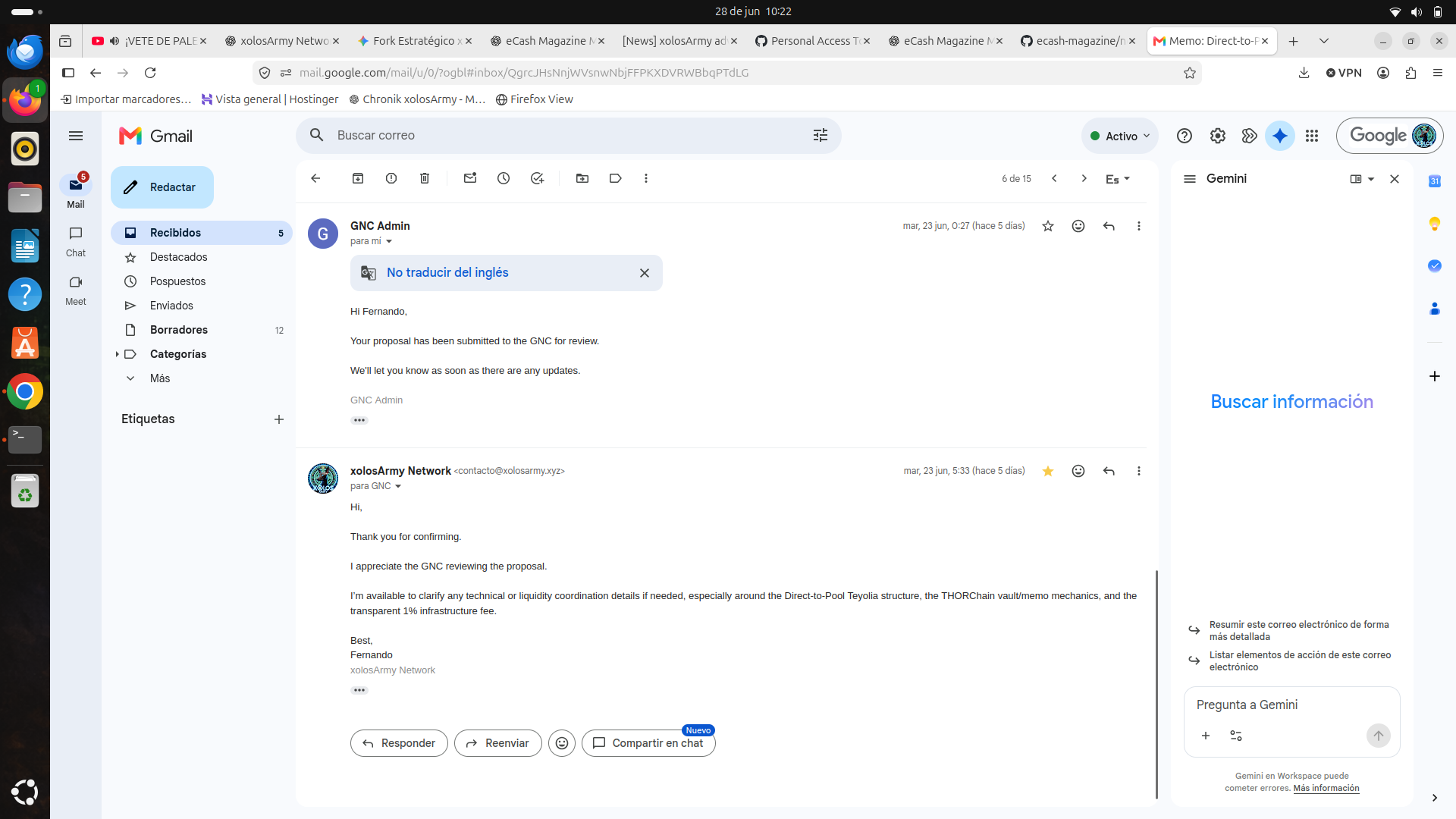
In parallel, it has been confirmed that the infrastructure project was formally submitted to the Global Network Council (GNC), the body responsible for funding the development of the eCash ecosystem.
Through community forums and channels, several users (including active figures like Mohamed.xec) have begun requesting visibility on the GNC's response times. As of press time, the proposal has been under review for several days without an official resolution or formal rejection from the council.
Additional documentation: Amaury, THORChain and the GNC
In addition to the conversations with Nate Novosel and Mohamed.xec, eCash Magazine México is adding two documentary elements that help explain the public coordination context around Teyolia, native XEC on THORChain and the proposal submitted to the GNC.
The first element is a direct conversation with Amaury Séchet, founder of eCash, where the public THORChain Space was shared. In that Space, Fernando from xolosArmy joined the THORChain community to discuss the community-led effort to bring native XEC to THORChain and move toward community-owned liquidity. Amaury’s response was short but meaningful: “well done”.
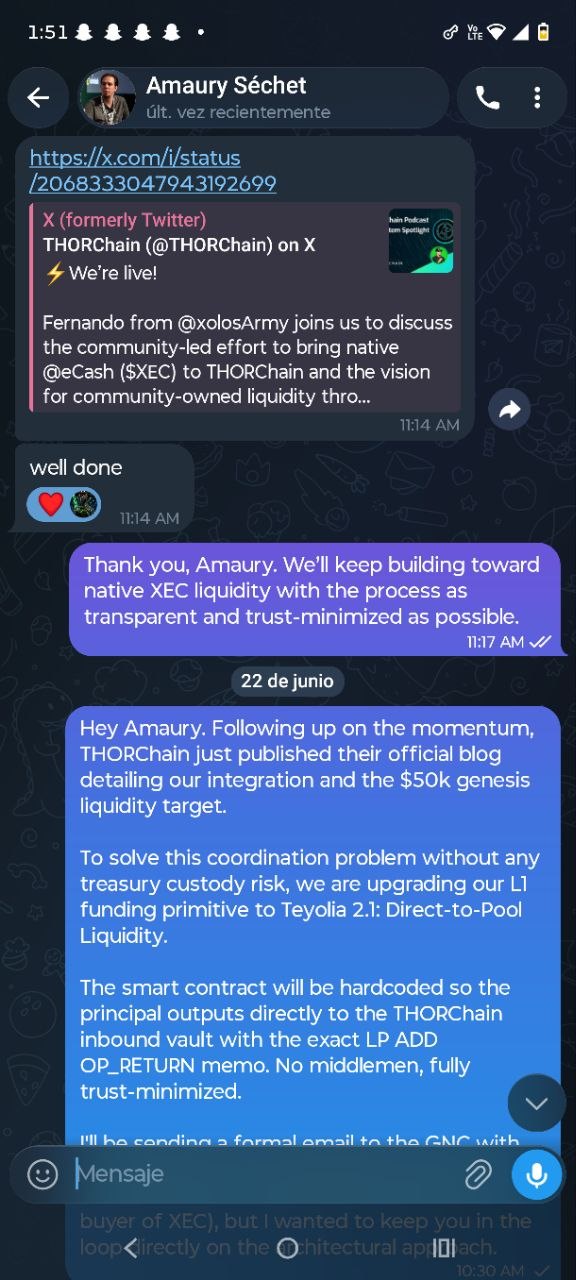
After that initial exchange, xolosArmy followed up by explaining that THORChain had published its official blog covering the integration and the initial $50k genesis liquidity target. The same message introduced the technical evolution toward Teyolia 2.1: Direct-to-Pool Liquidity, an approach designed to reduce treasury custody risk through programmed outputs to the THORChain inbound vault and a specific ADDLP OP_RETURN memo.
The second element is the correspondence sent to the GNC. This communication is part of xolosArmy’s attempt to present the proposal in a formal, structured and verifiable way to institutional actors within the eCash ecosystem.
The background of Teyolia 2.1-G
The project under evaluation, dubbed Teyolia 2.1-G Governance-Bridge, represents an architectural evolution designed after consultations with THORChain Core Devs.
The initiative seeks to coordinate social capital through smart contracts on eCash to fund a XEC/RUNE liquidity pool. To mitigate network risks and prevent the loss of Liquidity Provider (LP) tokens, the system directs the raised funds into a multi-signature wallet (developed by Tonalli), allowing the final injection into THORChain to be executed through a governance consensus rather than a blind script.
The openness to dialogue by institutional figures and the anticipation generated within the community reflect that the initiative has moved past the technical design phase and into the political coordination phase. July is expected to be a decisive month in determining the backing for this new infrastructure layer for eCash.

